

About me
I am a theoretical plasma physicist at the Institute for Advanced Study (IAS), Princeton. I use a combination of analytical calculations and numerical tools to investigate the role of multi-scale plasma processes in a wide range of space and astrophysical systems, most of which are in a turbulent state.
I grew up in Shenzhen, China, a city known for its rapid development and visionary spirit. Fascinated by the innovative power of physics, I pursued my undergraduate studies at Zhejiang University in Hangzhou, a place of timeless beauty. During that time, I also started research in plasma physics with collaborators at the Princeton Plasma Physics Laboratory (PPPL). Following my undergraduate years, I became a Ph.D. student at the Massachusetts Institute of Technology (MIT). With Prof. Nuno Loureiro. I studied fundamental processes in turbulent plasmas. One theme of my Ph.D. work pertains to the origin of the cosmic magnetic fields. Now, as a postdoc at the IAS and Princeton University, I work on multiple astrophysics and space-physics problems. My approach focuses on integrating non-equilibrium microphysics of plasmas into macroscopic astrophysical processes.
Check out my research CV and a list of my publications!
Research features
Magnetogenesis
How does the Universe magnetize?
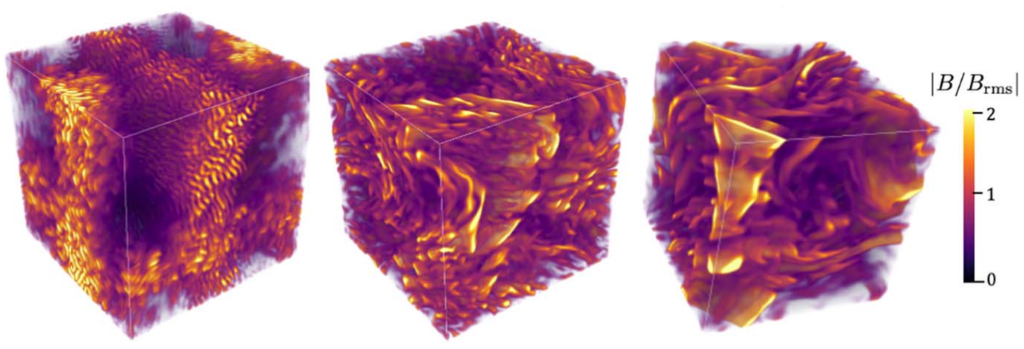
Astronomical observations suggest pervasive, dynamically strong magnetic fields in our Galaxy and the intracluster medium. Their origin remains a long-standing question in astrophysics and cosmology. Our work provides a unified paradigm for understanding the origin and evolution of cosmic magnetism by taking into account the effects of nonequilibrium micro-physics of collisionless plasmas on macroscopic astrophysical processes. Using analytical theory and first-principles numerical simulations, we demonstrate that the first magnetic fields can spontaneously emerge under generic turbulent motions, and their cross-scale, nonlinear coupling ensues the subsequent amplification of the fields until reaching energy equipartition with the turbulent flow. The ab-initio production of these equipartition fields under ubiquitous astrophysical turbulence advances a fully self-consistent, rigorous, and predictive explanation of the prevalence of cosmic magnetism.
Phase-space dynamics of kinetic turbulence
Intermittency and electron heating in the solar wind turbulence

Space and astrophysical plasmas exist in a turbulent state. Because collisions tend to be relatively rare, such plasmas are not readily amenable to a fluid-like description. Our work demonstrates the essential role of intrinsically kinetic effects in turbulent dynamics at scales below the ion Larmor radius, and the coupled nature of physical processes happening in real and velocity spaces. Our prediction of the direct connection between intense current structures, Landau damping, and electron heating, as well as of remarkable properties of the electron distribution function, provide important insights for interpreting recent high-resolution in-situ solar wind measurements from satellites.
Reconnection-governed decaying turbulence
Inverse energy cascade and spontaneous formation of large-scale structures
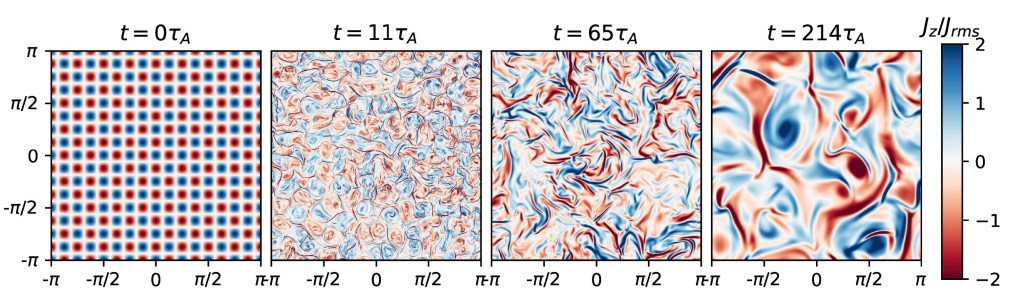
The solar corona, Earth’s magnetosheath and the heliopause are examples of heliospheric environments whose behavior is determined by complex, turbulent magnetic-field dynamics that possess certain structures. We conceptualize these environments by describing them as vast collections of interacting flux tubes ranging across a variety of spatial scales. A key process determining such interaction is magnetic reconnection, which enables the growth of the coherence length of the magnetic field via coalescence of flux tubes, as well as the transfer of magnetic energy to the plasma particles. By constructing analytical models and performing direct numerical simulations, our study has reached a rigorous understanding of the inverse transfer phenomena in such reconnection-governed turbulent systems. These results essentially explained how large-scale ordered structures of magnetic fields can emerge from turbulent space and astrophysical environments.
controlled nuclear fusion
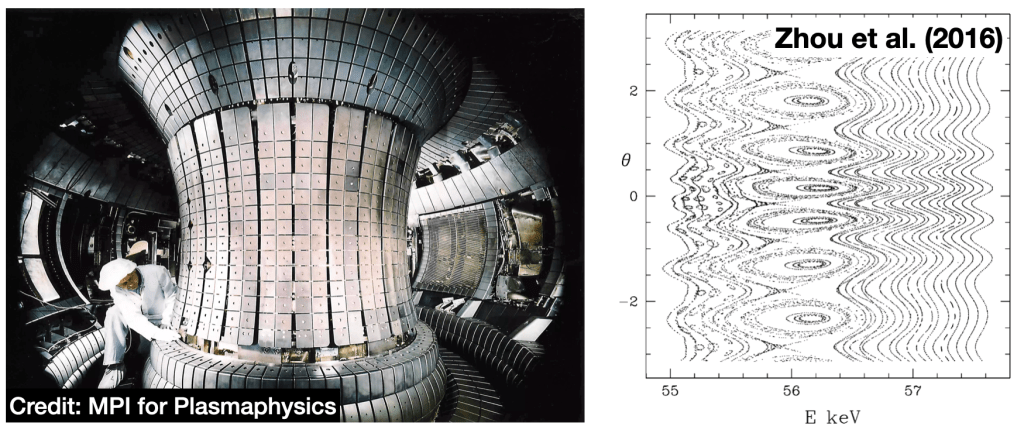
The Alfvén mode, a basic mode in tokamaks, can significantly modify the transport and confinement of energetic particles, while the loss of confinement of energetic particles will greatly diminish plasma heating and, thus, compromise the ability to achieve burning plasma. In order to understand the interplay between Alfven modes, energetic particles, and background thermal plasmas, we developed a novel method to determine the dependence of the saturation amplitude of the Alfvén modes in tokamaks on the collisionality of the thermal plasma. This methods allows the rapid prediction the saturation amplitude at a fast pace without performing full simulations that are computationally expensive. I have also participated in fusion-related projects including the evaluation of current-drive efficiency of helicon waves and designing diagnostics for a SPARC-like, high-field, compact, net-energy tokamak.
Contact information
munizhou@ias.edu
Institute for Advanced Study
1 Einstein Drive, Princeton, NJ 08540, USA
 Muni Zhou (周慕霓), Plasma Physicist