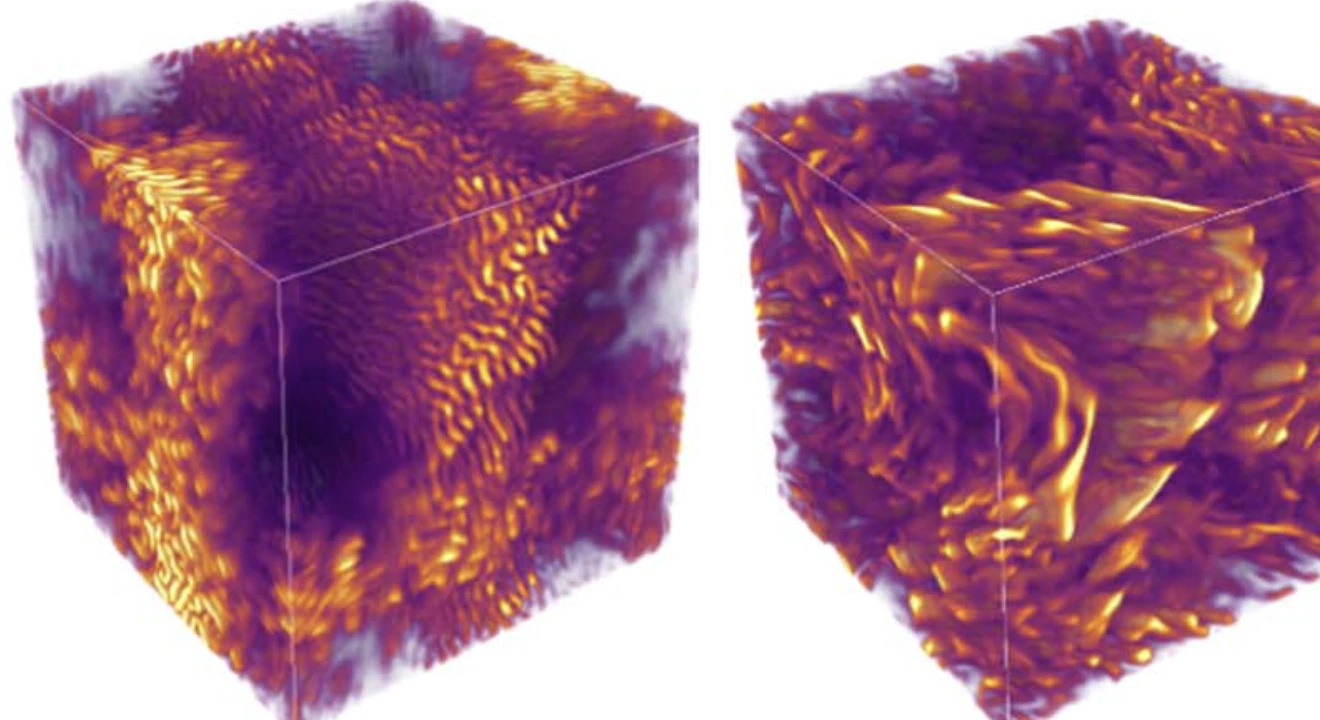
Magnetogenesis in a collisionless plasma: from Weibel instability to turbulent dynamo
The Astrophysical Journal, 960(1), 12 (2024).
How do magnetic fields grow, evolve, and relax?
Magnetic fields can grow dramatically when turbulent motions stretch and fold them, but their evolution does not end when amplification saturates. The resulting structures continue to decay, merge, and reorganize across a wide range of scales.
We investigate turbulent dynamo amplification together with the subsequent relaxation of magnetic fields. Our work asks how reconnection, pressure anisotropy, particle heating, and other kinetic effects determine the field strength, characteristic scale, and long-term evolution of collisionless plasmas.
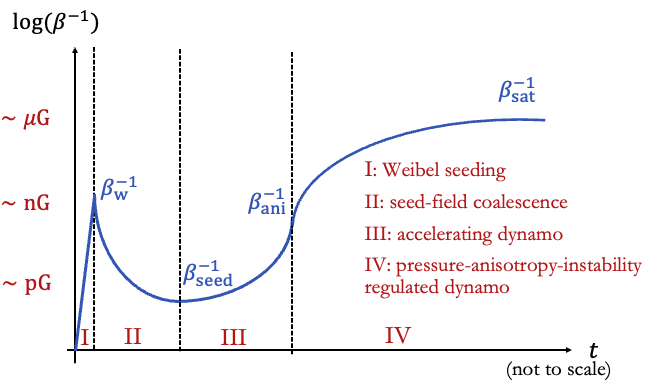
How do magnetic fields emerge, amplify, and evolve in a collisionless plasma?
Cosmic magnetic fields may begin as weak seeds and then be amplified by turbulent plasma flows, but these two stages have often been studied separately. We develop a unified, first-principles picture of how an initially unmagnetized collisionless plasma can generate, amplify, and sustain magnetic fields. Large-scale motions create pressure anisotropy through phase mixing, triggering the Weibel instability and producing microscopic seed fields. Once the plasma becomes magnetized, the fields couple to the turbulent flow and are stretched and amplified. Additional kinetic instabilities scatter particles, regulate the field structure, and support the turbulence. The dynamo ultimately raises the magnetic energy toward equipartition with the turbulent flow, providing a self-consistent pathway from an unmagnetized plasma to dynamically significant cosmic magnetic fields.
The magnetic field evolves through several connected phases. Weibel seeding first creates fields at kinetic scales; these seed structures then coalesce before the large-scale flow drives an accelerating dynamo. As the field grows, pressure-anisotropy instabilities become increasingly important: their fluctuations scatter particles, alter the effective plasma collisionality, and regulate the final stage of amplification. Following these phases together reveals how the characteristic field strength, scale, and morphology change continuously from the first microscopic seeds to a saturated, dynamically important magnetic field.
Related publications
The Astrophysical Journal, 960(1), 12 (2024).
Led by Dawei Dai
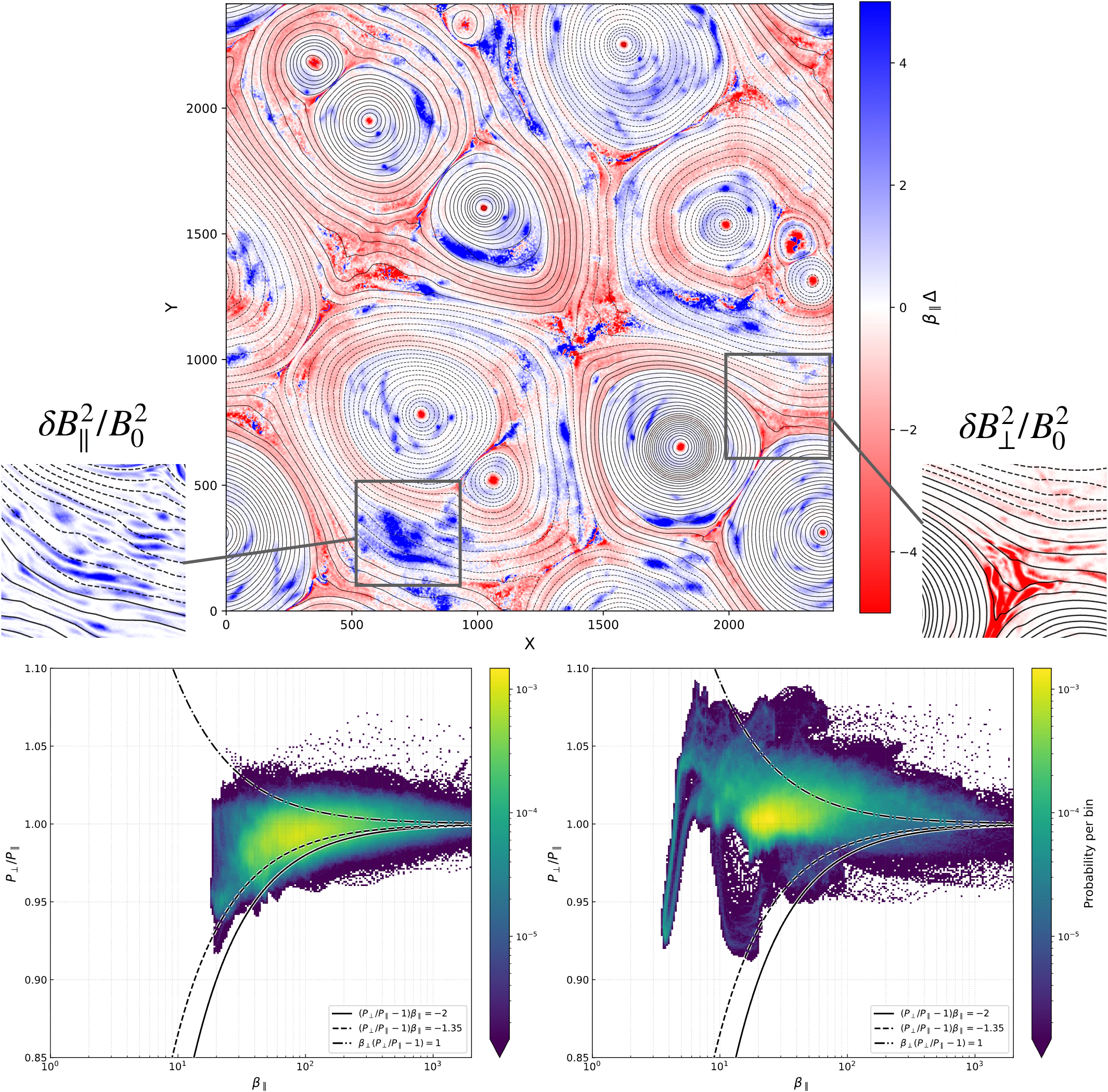
How do tangled magnetic fields decay and reorganize when particle collisions are rare?
Magnetic fields in space and astrophysical plasmas are often tangled and concentrated at relatively small scales. As the turbulence decays, magnetic reconnection allows neighboring structures to merge: magnetic energy decreases while the characteristic size of the surviving structures grows. Using two- and three-dimensional hybrid-kinetic simulations, we show that this relaxation remains self-similar in a collisionless plasma, but proceeds more slowly than predicted by fluid theories. As the field weakens, thermal pressure becomes increasingly important and slows reconnection, setting new rates for the decay of magnetic energy.
Reconnection also converts a nearly constant share of the released magnetic energy into ion heat, preferentially along the magnetic field. This creates pressure anisotropy and excites the firehose instability. Rather than stopping the transfer of magnetic energy toward larger scales, the resulting small-scale fluctuations regulate the anisotropy in reconnection outflows and leave the surrounding plasma ready for the next merger. The magnetic field can therefore continue to reorganize into larger, more coherent structures even when kinetic plasma effects are strong. This provides a possible route by which small-scale magnetic fields evolve into the large-scale fields found throughout the Universe.
Related manuscript in progress
In preparation