Collisional dependence of Alfvén mode saturation in tokamaks
Plasma Physics and Controlled Fusion, 58(12), 125006 (2016).
How can we understand and control energetic-particle transport?
Controlled fusion requires plasmas to remain hot, confined, and stable while currents, waves, energetic particles, and exhaust flows interact across scales. Predicting these interactions is essential for maintaining confinement and designing practical ways to heat and control the plasma.
We study Alfvén-mode saturation, wave-driven current, energetic-particle transport, and plasma exhaust in magnetic mirrors. By combining analytical theory with numerical models, we seek ways to predict plasma behavior and guide the operation of fusion experiments.
How do collisions affect the nonlinear saturation of Alfvén modes?
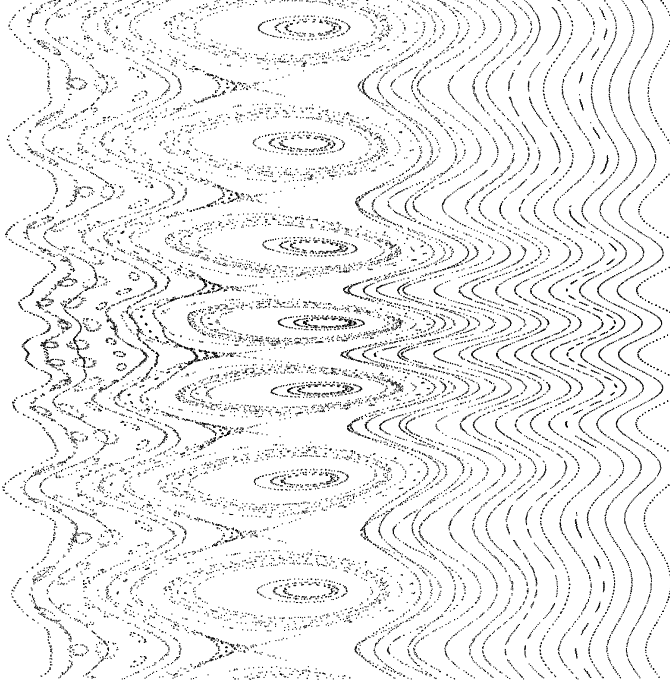
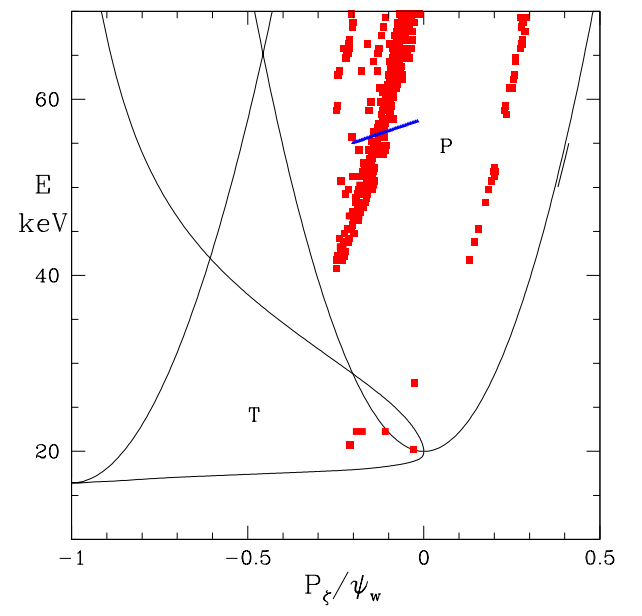
Toroidal Alfvén eigenmodes (TAEs) can redistribute the energetic particles that heat a fusion plasma. If these modes grow too large, energetic particles can be moved away from where their energy is most useful—or even be lost—reducing plasma heating and making high-performance confinement more difficult. Predicting the amplitude at which a TAE stops growing is therefore essential for understanding energetic-particle transport and anticipating the performance of future fusion devices.
TAEs grow by resonantly exchanging energy with a particular group of energetic particles. As the mode grows, it mixes particles within this resonance layer and flattens the part of the particle distribution that drives the instability, pushing the mode toward saturation. Collisions compete with that process by scattering nearby particles into the resonance layer and replenishing the drive. Collisionality therefore controls how quickly the resonance can be refilled and, in turn, how large the mode becomes before it saturates.
We developed a simple way to determine this dependence without running a new, large nonlinear simulation for every collision rate. By balancing the time required for the mode to mix particles inside the resonance with the time required for collisions to diffuse nearby particles across the resonance width, we can predict the saturation amplitude and its scaling with collisionality. The method captures the simulation results as long as the mode remains below the amplitude at which stochastic particle loss becomes important.
Related publications
Plasma Physics and Controlled Fusion, 58(12), 125006 (2016).
How do helicon and lower-hybrid current drive compare?
A tokamak relies on a strong current flowing through the plasma to help create the twisted magnetic field that confines it. In present experiments, much of this current can be induced by a central transformer, but transformer drive is inherently pulsed. A practical fusion power plant will need efficient non-inductive current drive to sustain long or steady-state operation, shape the current profile, and maintain the magnetic configuration needed for stable, well-confined plasma.
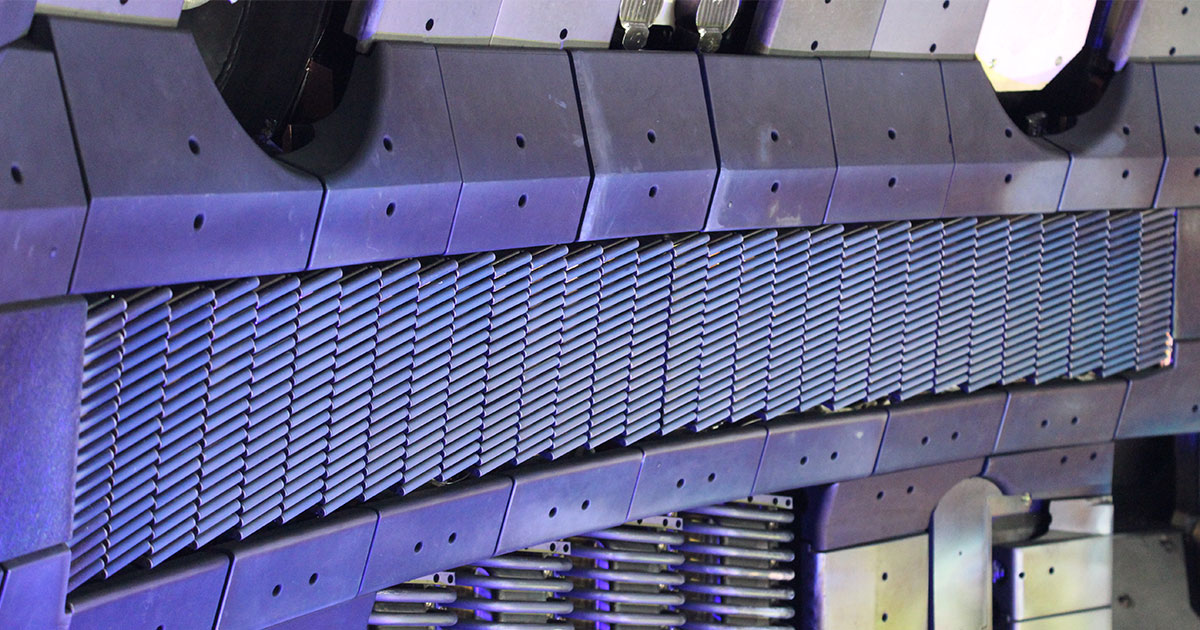
Helicon waves offer a promising way to provide that current in the hot, dense plasmas expected in future reactors. These radio-frequency waves can transfer momentum preferentially to electrons moving in one direction, creating a net parallel current. They are especially attractive because they may penetrate and deposit power in reactor-relevant conditions where some established current-drive techniques become less effective. Determining how efficiently helicon waves convert injected radio-frequency power into plasma current is therefore central to judging whether they can become a practical tool for fusion devices.
We developed a theoretical calculation of the parallel current driven by helicon waves in realistic tokamak geometry, together with the radio-frequency power absorbed by passing electrons. The calculation retains the correlated interactions experienced by electrons as they make repeated poloidal transits through the applied wave field, and uses an adjoint method to evaluate the resulting current-drive efficiency. Comparing the result with lower-hybrid current drive, we found that the two schemes have the same efficiency in the single-frequency, single-mode-number limit. This places helicon current drive on a firm theoretical footing as a plausible and potentially useful option for sustaining current in future tokamaks.
Related publications
Journal of Plasma Physics, 89(4), 905890405 (2023).
Led by Joseph Kuester
Can voltages applied at the ends of a magnetic mirror control the confined plasma?
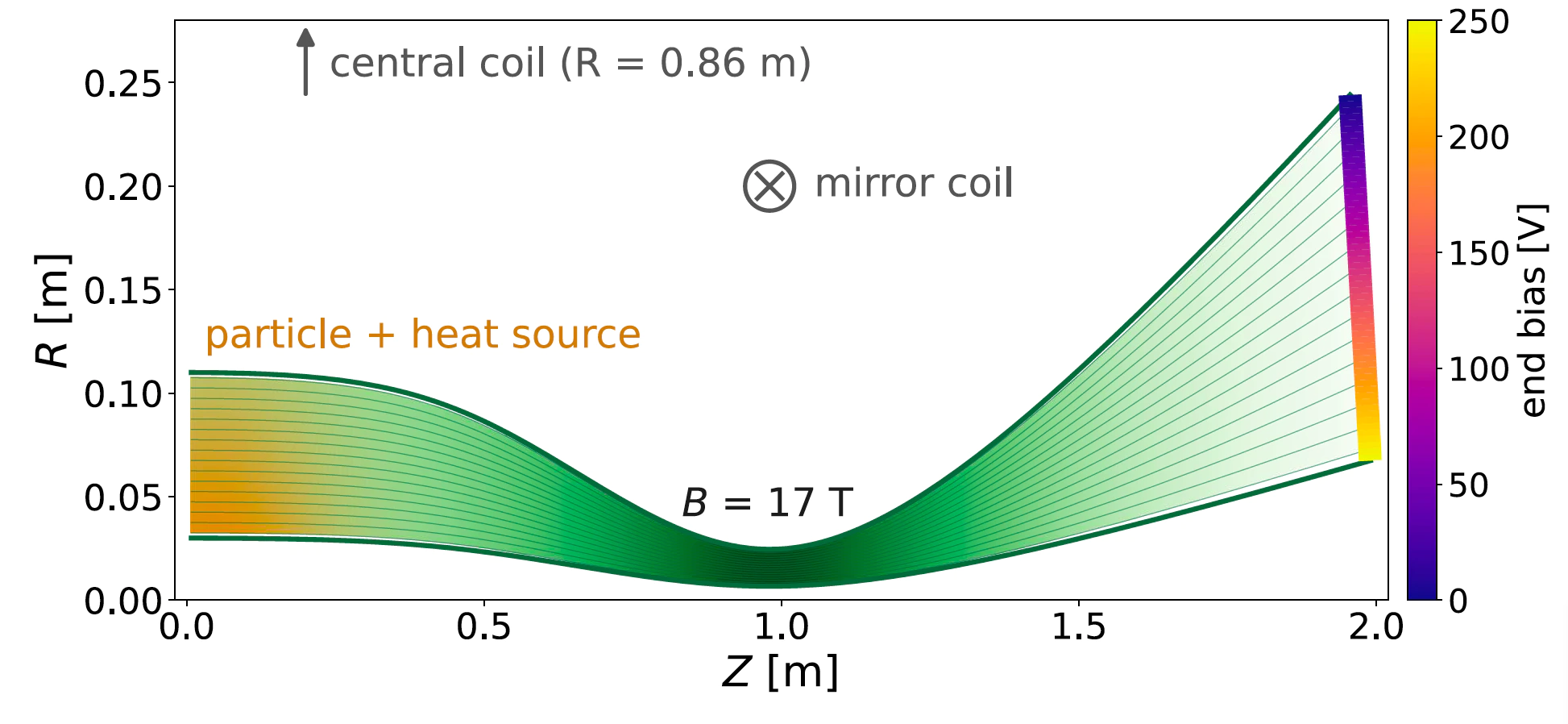
Magnetic mirrors confine fusion plasmas along open magnetic-field lines, allowing particles and heat to escape into an exhaust region. We develop a two-dimensional fluid model of plasma and neutral gas in a WHAM-based geometry, extending from the midplane through the magnetic throat to a biased target plate. A JAX-based solver directly finds steady-state density, temperature, flow, and electric-potential profiles using a Newton-like method, rather than waiting for time-dependent simulations to settle.
Across the conditions tested, the target voltage reaches the midplane with little change. This suggests that end biasing could control plasma rotation and help suppress interchange instabilities, although stability itself is not calculated here. Neutral recycling also has a strong effect: charge exchange transfers momentum from ions to neutrals, slowing the exhaust from supersonic to subsonic speeds under strong recycling. The plasma becomes cooler and denser, making parts of the exhaust collisional. These results connect electrical control of the confined plasma to exhaust conditions and identify where a kinetic description is needed.
Related presentation
Poster presentation at APS DPP 2026