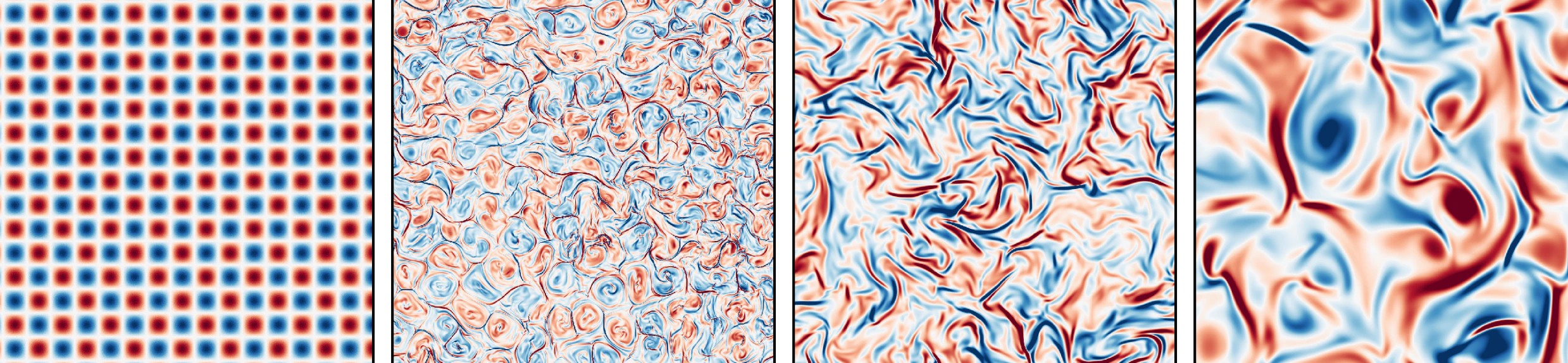
Multi-scale dynamics of magnetic flux tubes and inverse magnetic energy transfer
Journal of Plasma Physics, 86(4), 535860401 (2020).
How do large magnetic structures emerge from small-scale turbulence?
Magnetic reconnection changes how field lines connect and rapidly converts magnetic energy into particle motion and heat. In a turbulent plasma, many reconnection events can also reorganize the magnetic field collectively and build structures much larger than the original fluctuations.
We study magnetic-island and flux-tube mergers, turbulent decay, and kinetic reconnection. Our research asks when reconnection drives inverse magnetic-energy transfer, how collisionless effects modify that process, and how multiscale magnetic structures self-organize over time.
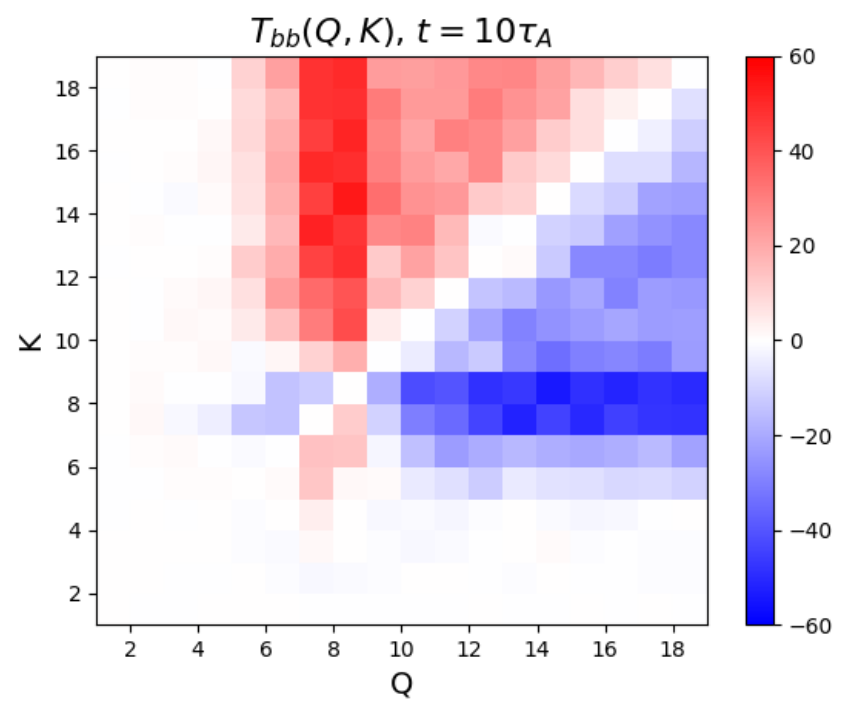
How does magnetic reconnection drive an inverse cascade?
Magnetic turbulence usually carries energy from large scales to small ones, yet a decaying magnetized plasma can also transfer magnetic energy in the opposite direction. This project shows how reconnection enables that inverse cascade: magnetic islands and flux tubes repeatedly merge, leaving behind fewer, larger structures as the total magnetic energy decays. A hierarchical merger model connects the reconnection timescale to the growth of the magnetic correlation length, while simulations show that this mechanism operates in both two and three dimensions even when the magnetic field has no net helicity.
Related publications
Journal of Plasma Physics, 86(4), 535860401 (2020).
Monthly Notices of the Royal Astronomical Society, 501(2), 3074-3087 (2021).
Physical Review Research, 1(1), 012004 (2019).
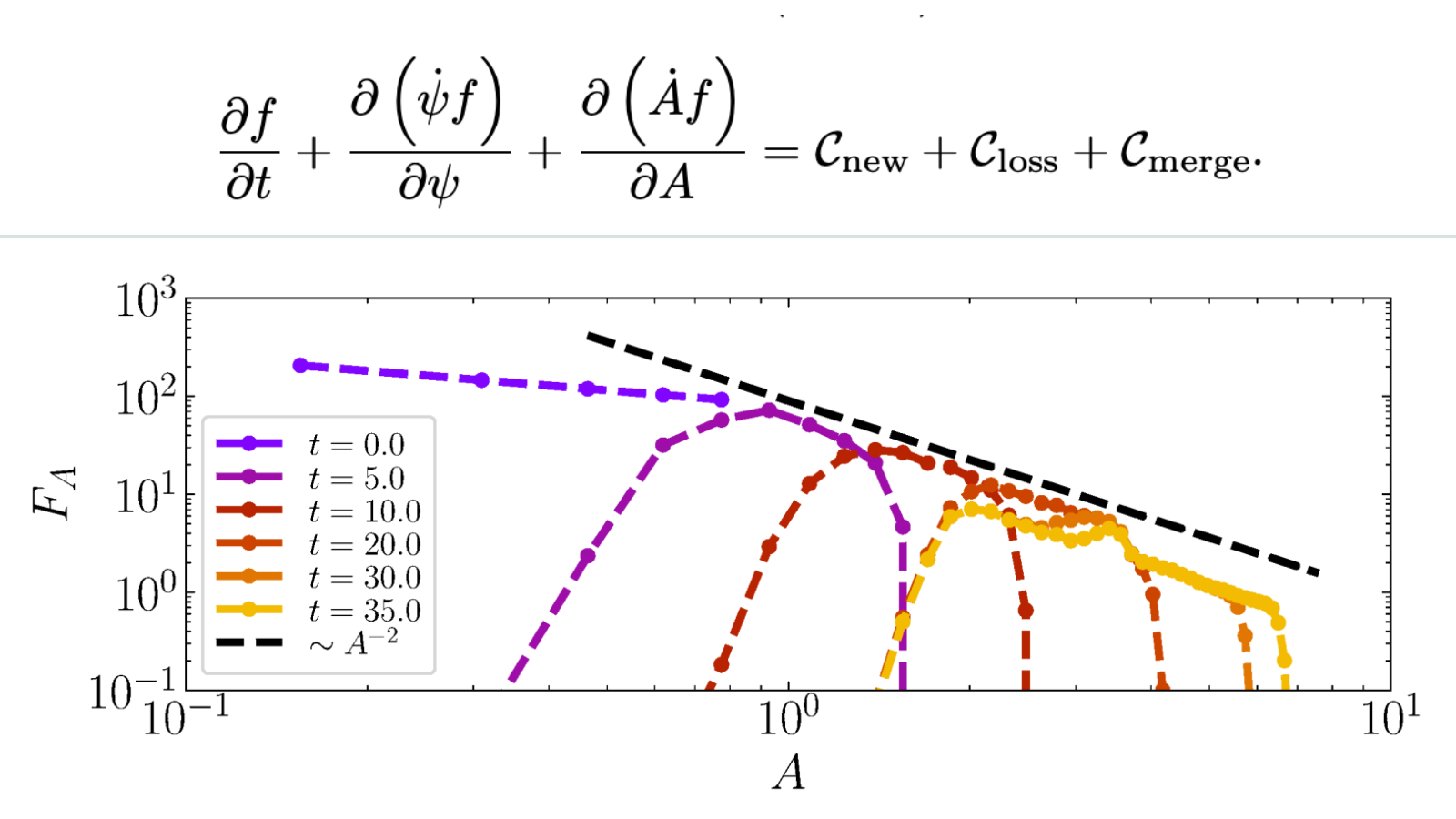
How do interacting magnetic flux tubes transfer energy across scales?
A turbulent plasma can contain a broad population of magnetic islands rather than a single characteristic structure. This project develops a statistical model that follows how islands of different sizes and magnetic fluxes are created, lost, and combined through reconnection. By connecting many individual coalescence events to the evolving distribution of the whole population, the model explains how progressively larger magnetic structures emerge and provides a multiscale description of inverse magnetic-energy transfer.
Related publications
Journal of Plasma Physics, 87(6), 905870620 (2021).
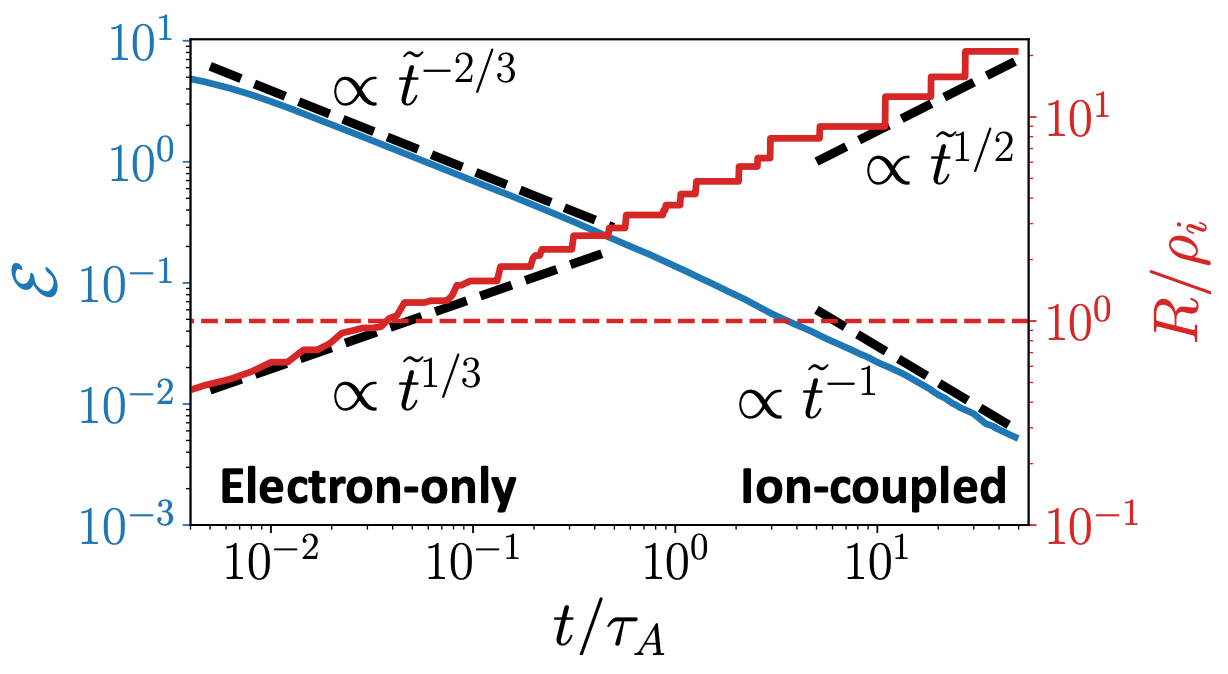
How does electron-scale reconnection affect magnetic-energy transfer?
Below the characteristic ion scale, electrons can reconnect and form fast outflows while the heavier ions remain largely decoupled. This project shows that repeated electron-only mergers can still move magnetic energy toward progressively larger scales. Theory and fully kinetic simulations reveal distinct scaling laws for the magnetic energy and structure size in the electron-only regime, and follow their transition toward ion-coupled reconnection as the growing structures approach ion scales.
Related publications
Physical Review Letters, 134(15), 155201 (2025).
How does finite plasma beta control the rate of electron-only reconnection in an electron–ion plasma?
Electron-only reconnection occurs when electrons reconnect and form fast outflows before the heavier ions can fully respond, a regime relevant to the short current sheets found in plasma turbulence. This project asks how plasma pressure, measured by beta, controls the global reconnection rate. By extending island-coalescence theory to finite beta and testing it with fully kinetic particle-in-cell simulations, we find that the merger rate increases with beta and decreases with island size, yielding a scaling that connects the large-scale supply of magnetic flux to the electron-scale reconnection layer.
Related manuscript in progress
In preparation
Led by collaborator, Dr. Tak Chu Li
Do extended reconnection events embedded in turbulence follow the dynamics of the turbulence itself?
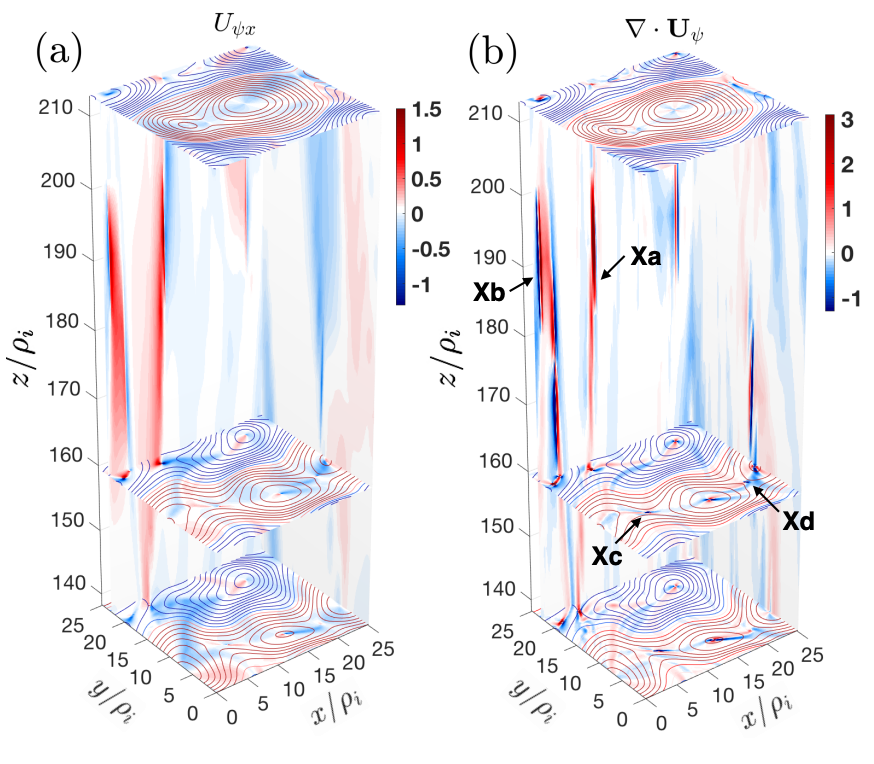
Magnetic reconnection and turbulence continually reshape one another, but it is not obvious whether an extended reconnection event embedded in turbulence follows the dynamics of the turbulence itself. Using a magnetic-flux-transport method to identify and measure active X-lines in a fully kinetic turbulent plasma, this project finds that it does: the extended reconnection structures grow and spread with a geometry consistent with critical balance (Goldreich–Sridhar 1995). The result directly connects the scale of an extended X-line to the multiscale organization of its turbulent environment.
Related publications
Physical Review Letters, 131(8), 085201 (2023).