Electron heating in kinetic-Alfvén-wave turbulence
Proceedings of the National Academy of Sciences, 120(23), e2220927120 (2023).
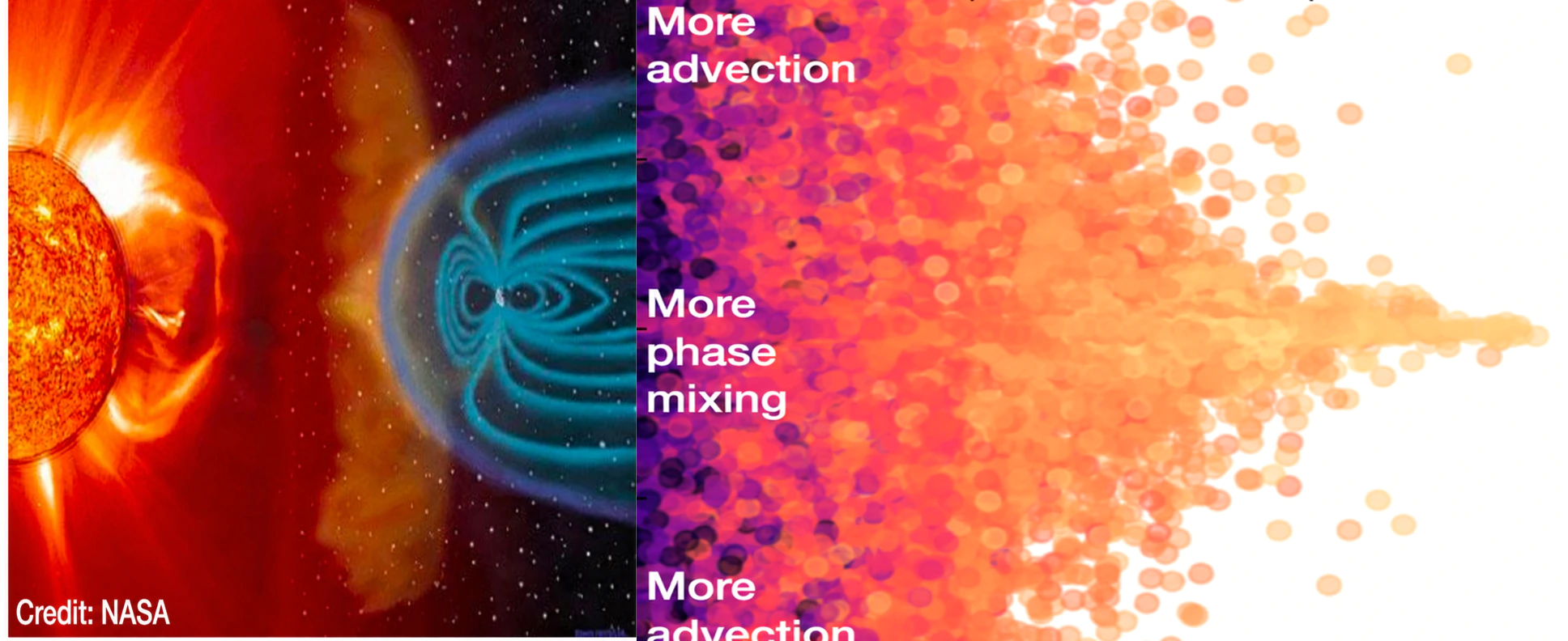
Where does turbulent energy go when collisions are rare?
In the solar wind, a fluid description cannot capture the entire turbulent cascade. At small scales, particle motions and the shape of the velocity distribution become essential to understanding the transfer and dissipation of energy.
Our research examines the connection between intermittent current structures, phase mixing, Landau damping, and electron heating. Combining theory with kinetic simulations lets us ask how energy moves through both physical and velocity space.
How does turbulent energy become electron heat?
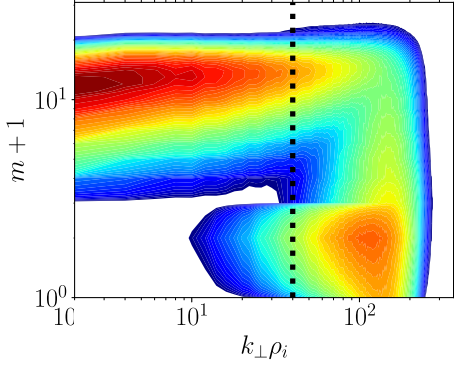
At scales smaller than an ion’s gyroradius, solar-wind turbulence evolves not only through structures in physical space but also through increasingly fine structure in the particles’ velocity distribution. Kinetic Alfvén waves transfer energy into this velocity-space structure through phase mixing and Landau damping, providing an efficient route to electron heating. Plasma echoes could, in principle, reverse this transfer and return energy to the electromagnetic fluctuations. We find, however, that the nonlinear interactions responsible for echoes are locally weakened around spontaneously formed current sheets. Phase mixing and Landau damping can therefore proceed there with less opposition, explaining why electron heating is concentrated near these intermittent structures. This connects the geometry of turbulence in physical space directly to how its energy is converted into heat in velocity space.
Related publications
Proceedings of the National Academy of Sciences, 120(23), e2220927120 (2023).
What determines the spectrum of kinetic-Alfvén-wave turbulence?
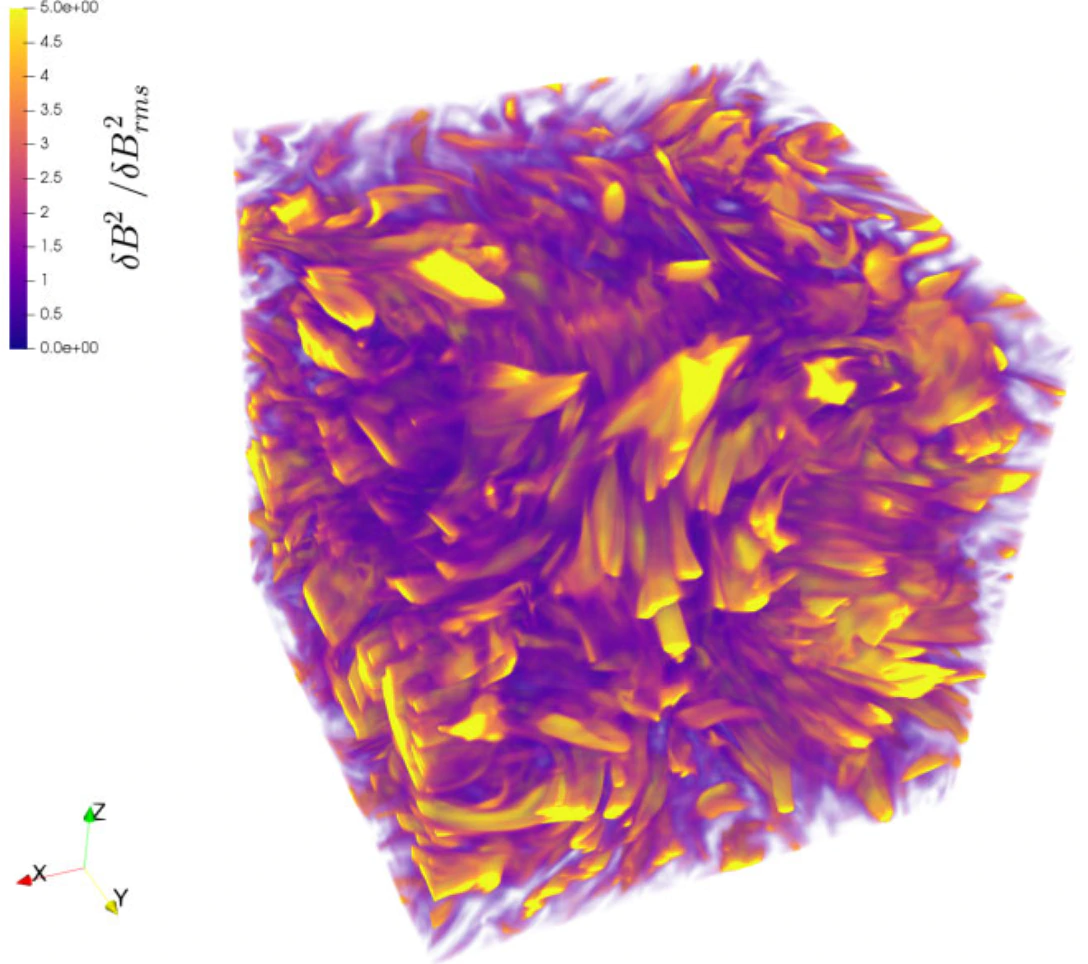
Measurements of the solar wind show that electromagnetic fluctuations develop a steeper spectrum below the ion gyroradius than a simple kinetic-Alfvén-wave cascade would predict. Two mechanisms could explain this: intermittency, which concentrates the turbulent energy into sparse sheet-like structures, or tearing instability, which could break apart increasingly elongated structures and control the cascade. By comparing simulations with different mechanisms for breaking magnetic flux freezing, we find the same spectrum in every case. The fluctuations also remain approximately isotropic in the plane perpendicular to the background magnetic field, rather than becoming progressively elongated as tearing mediation requires. Higher-order statistics instead reveal quasi-two-dimensional, sheet-like intermittent structures. These results identify intermittency, rather than tearing mediation, as the mechanism that sets the sub-ion spectrum in this regime and help interpret spacecraft measurements of kinetic turbulence in the solar wind.
Related publications
Monthly Notices of the Royal Astronomical Society, 524(4), 5468-5476 (2023).
Led by Dr. Vincent David
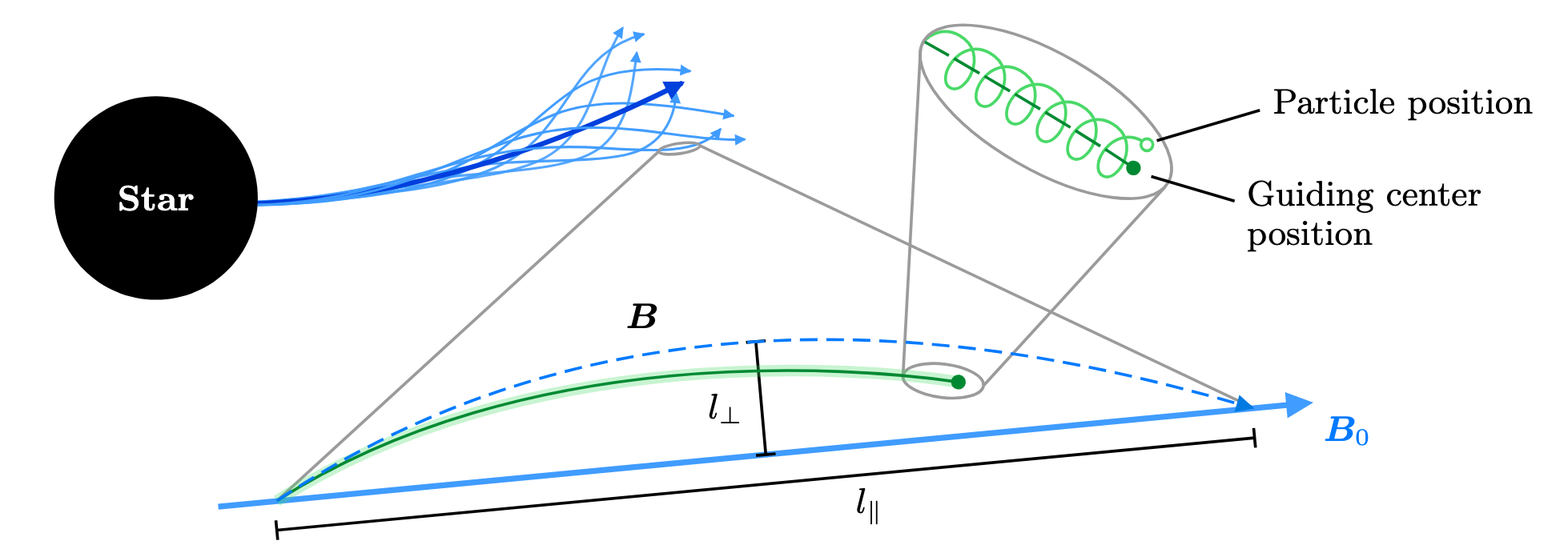
We derive a set of nonlinear gyrokinetic equations to describe plasma turbulence in spatially varying backgrounds with general magnetic-field geometry. By averaging over particles’ rapid gyromotion, the equations capture how slower turbulent motions interact with background flows, gradients, and curved magnetic fields.
This framework lets us study how realistic solar-wind conditions shape turbulence and the transfer of energy to ions and electrons. The present model uses a prescribed, stationary background; predicting how that background evolves in response to turbulence will require coupling these equations to a transport model.
Related manuscript in progress
In preparation