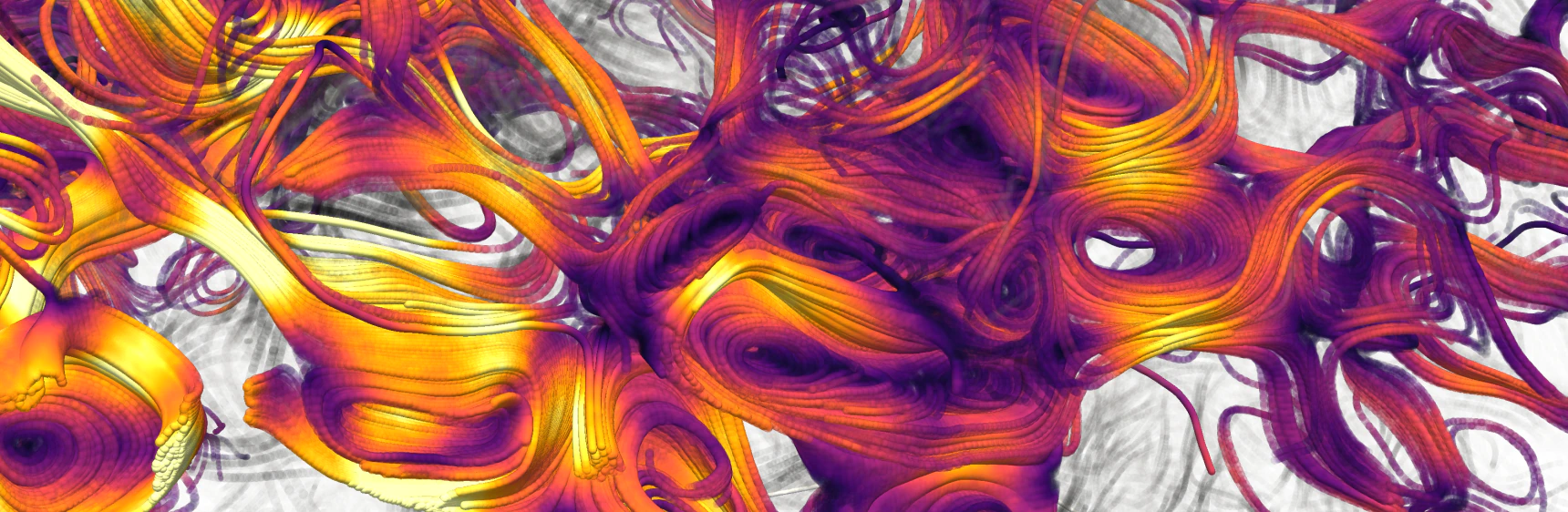
Spontaneous magnetization of collisionless plasma
Proceedings of the National Academy of Sciences, 119(19), e2119831119 (2022).
Where do the first cosmic magnetic fields come from?
Magnetic fields fill planets, stars, galaxies, and the space between them, yet many cosmic environments may have begun nearly unmagnetized. Before turbulence can amplify a magnetic field, some plasma process must first create a microscopic seed.
We study how collisionless particle dynamics, velocity-space anisotropy, and the Weibel instability generate those first fields. We then ask how the seeds evolve, merge, and connect kinetic plasma physics to the large-scale magnetization of the Universe.
How can a shear flow generate the first magnetic fields?
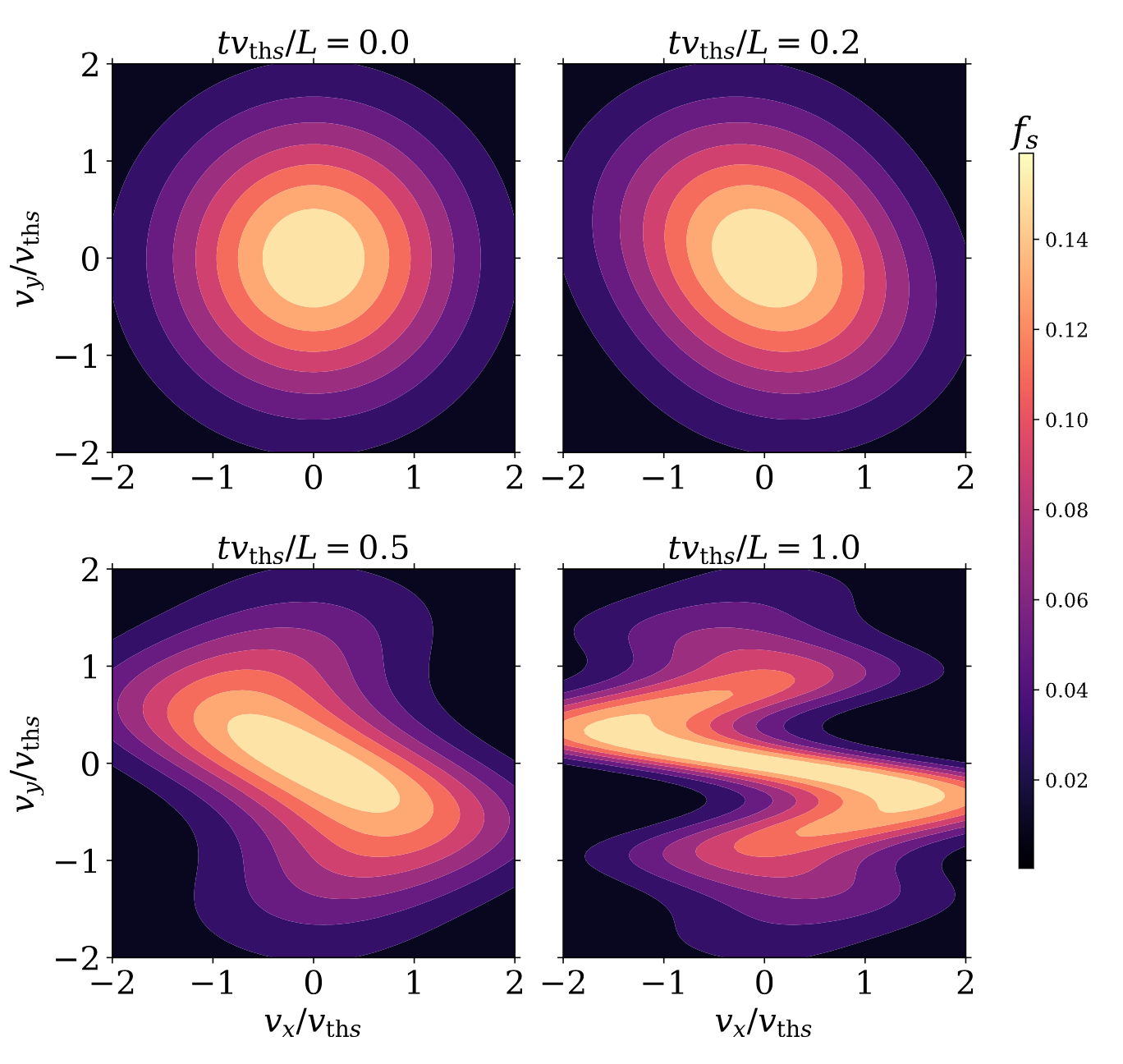
Magnetic fields pervade planets, stars, galaxies, and the diffuse matter between galaxies, shaping how cosmic plasmas move, radiate, and exchange energy. Yet many astrophysical environments may begin essentially unmagnetized, and a turbulent dynamo can amplify magnetic fields only after some earlier process supplies a seed. This project asks how an ordinary large-scale plasma flow can create that first field spontaneously, without requiring any pre-existing magnetization.
The key is that a shear flow varies across space. In a collisionless plasma, particles with different thermal velocities freely stream across the shear and carry momentum between neighboring regions. This phase mixing progressively distorts the velocity distribution and generates pressure anisotropy, storing free energy in particle motion. Once the anisotropy becomes sufficiently strong, it triggers the Weibel instability, which converts that free energy into microscopic magnetic fields. As those fields grow, they bend and trap particle trajectories, reduce the anisotropy, and eventually saturate the instability. Using a pair plasma, in which the two species have equal masses and therefore respond on the same kinetic timescale, this project isolates the fundamental mechanism by which a generic shear flow can magnetize an initially unmagnetized plasma.
Related publications
Proceedings of the National Academy of Sciences, 119(19), e2119831119 (2022).
How are magnetic seed fields generated in an initially unmagnetized electron-ion plasma?
The spontaneous-magnetization project establishes the basic mechanism in a pair plasma, where the positively and negatively charged particles have equal masses. Most ordinary astrophysical plasmas instead contain light electrons and much heavier ions. This mass separation introduces two very different kinetic timescales: electrons rapidly develop anisotropy, excite electron-scale Weibel modes, and become magnetized, while the ions can remain comparatively unmagnetized and continue to carry most of the bulk kinetic energy. Electron saturation therefore need not mark the end of magnetogenesis; it can be only the first stage of a more complex evolution.
Using high-resolution, fully kinetic simulations with a realistic electron-to-ion mass ratio, this project follows the plasma beyond that initial electron-scale saturation. We find that the ions continue to sustain the shear and eventually drive a second, ion-dominated instability. This later stage draws on the much larger reservoir of ion kinetic energy, reorganizes the field toward ion scales, and amplifies the magnetic energy by orders of magnitude beyond the electron saturation level. The result identifies a kinetic route to stronger and more persistent seed fields in realistic electron-ion plasmas, providing more favorable initial conditions for subsequent magnetic relaxation and turbulent-dynamo amplification in astrophysical systems.
Related manuscript in progress
In preparation
How can pressure-anisotropy instabilities reshape the relaxation of Weibel-generated magnetic fields?
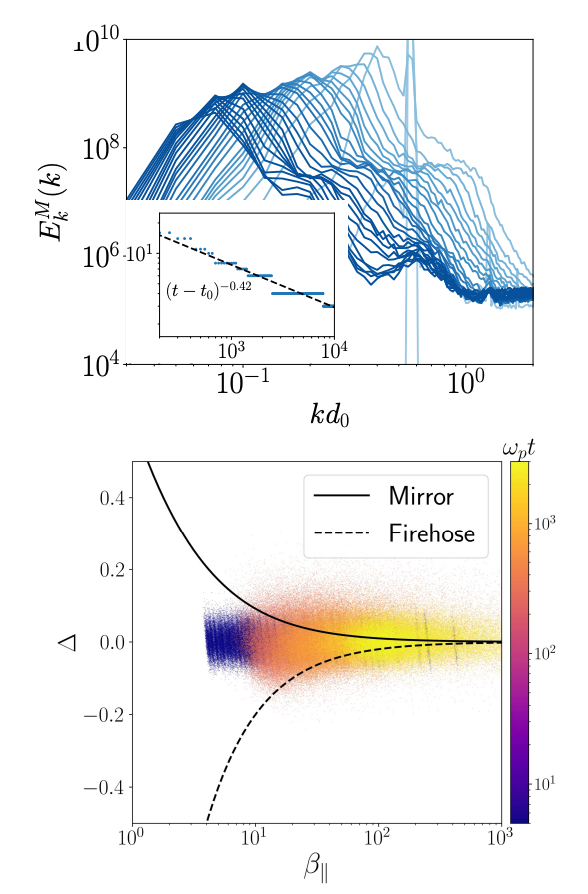
After the Weibel instability generates magnetic fields on microscopic scales, those fields must merge and transfer energy to larger scales if they are to survive and contribute to cosmic magnetization. During this decay, changes in magnetic-field strength can produce pressure anisotropy and trigger mirror or firehose instabilities. This project explores how the firehose instability can release magnetic-field-line tension—the restoring force that helps drive reconnection—and thereby potentially slow the merging of magnetic structures in some plasma regimes. Rather than establishing a universal suppression of inverse transfer, the study identifies a kinetic effect that may alter the relaxation pathway. How the nonlinear evolution proceeds remains an open question, because three-dimensional dynamics, guide fields, magnetization, and other plasma regimes may substantially change the outcome.
Related publications
The Astrophysical Journal Letters, 995(2), L46 (2025).
Led by Dion Li at MIT
How do kinetic plasma processes constrain the relaxation of Weibel-generated magnetic fields?
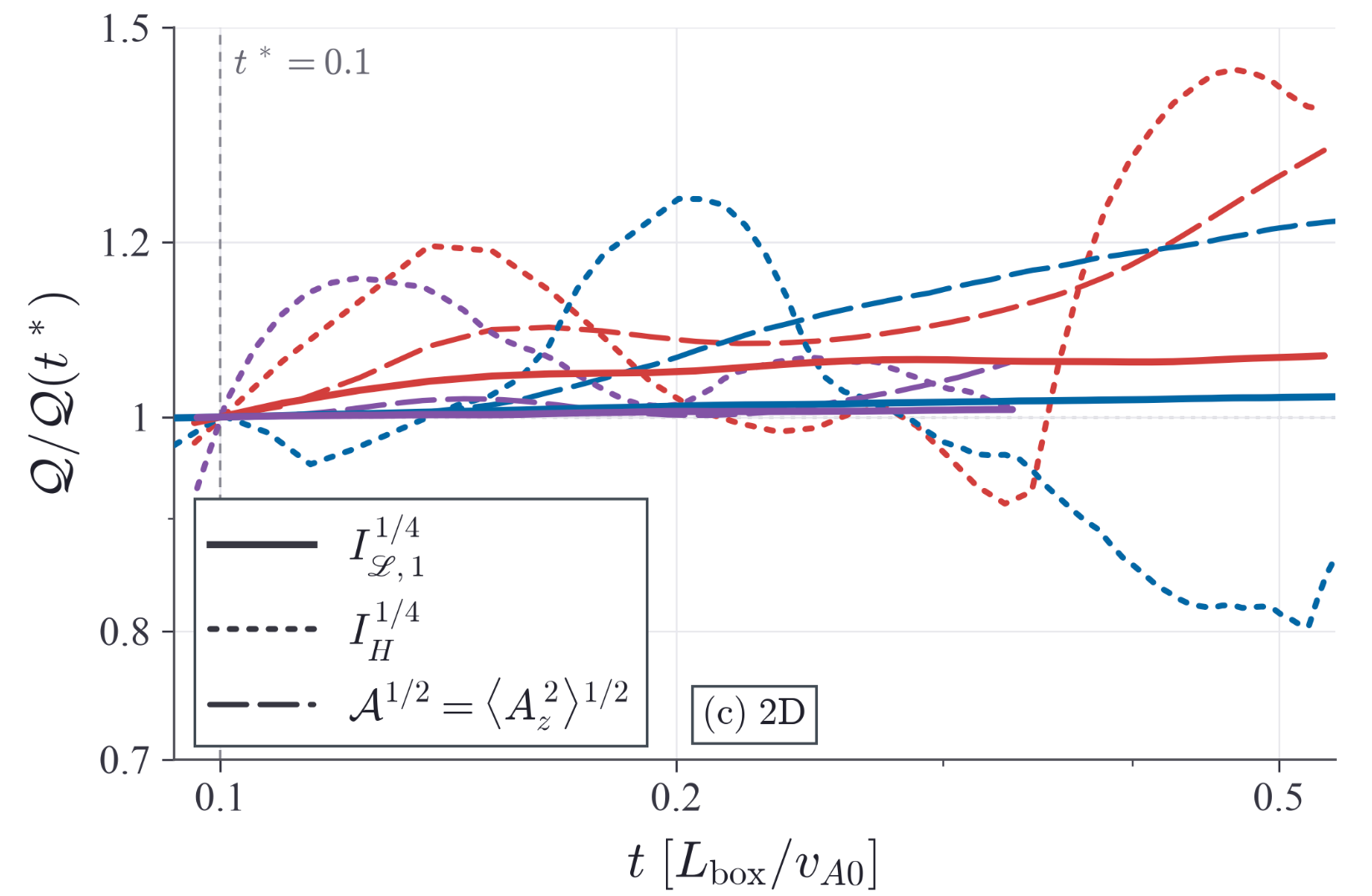
The Weibel instability can generate strong magnetic fields on microscopic plasma scales, but creating those fields is only the beginning of the story: to explain phenomena such as gamma-ray-burst afterglows, we also need to know how long the fields survive downstream of a collisionless shock and how they evolve over much longer times. Small-scale magnetic turbulence can decay rapidly, while reconnection and the merger of current-carrying structures can simultaneously move magnetic energy toward larger scales. This project asks what constrains that relaxation when the usual ideal-fluid invariants no longer apply. Using two- and three-dimensional electron–ion particle-in-cell simulations, we find that a newly defined kinetic version of the Saffman helicity integral remains conserved even when conventional invariants fail in the kinetic range. This constraint links the weakening of the magnetic field to growth of its characteristic scale, providing a framework for the long-term evolution of Weibel-generated fields, while magnetic reconnection supplies the physical timescale for that evolution.
Related manuscript in progress
In preparation
Led by collaborator, Dr. Hanjue Zhu (朱涵珏) at IAS/Princeton
How can plasma magnetogenesis connect to cosmological questions?