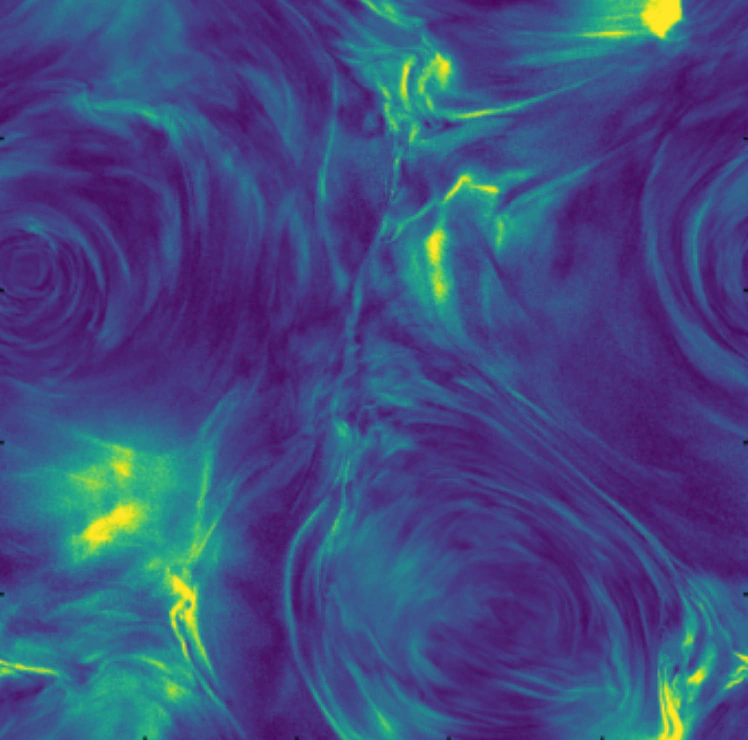
Radiative relativistic turbulence as an in situ pair-plasma source in blazar jets
The Astrophysical Journal, 987(2), 159 (2025).
What happens when turbulence, radiation, and pair creation evolve together?
Plasmas around compact objects can be so energetic that radiation and electron–positron pair creation become part of the dynamics. These processes can change the particle population, redistribute energy, and feed back on the turbulence that produced the radiation.
We study the coupled evolution of turbulent particle energization, radiative losses, pair loading, and relativistic flows. Our work connects particle-scale kinetic physics with larger-scale plasma dynamics to understand composition and high-energy emission in extreme astrophysical environments.
How does radiation modify relativistic plasma turbulence?
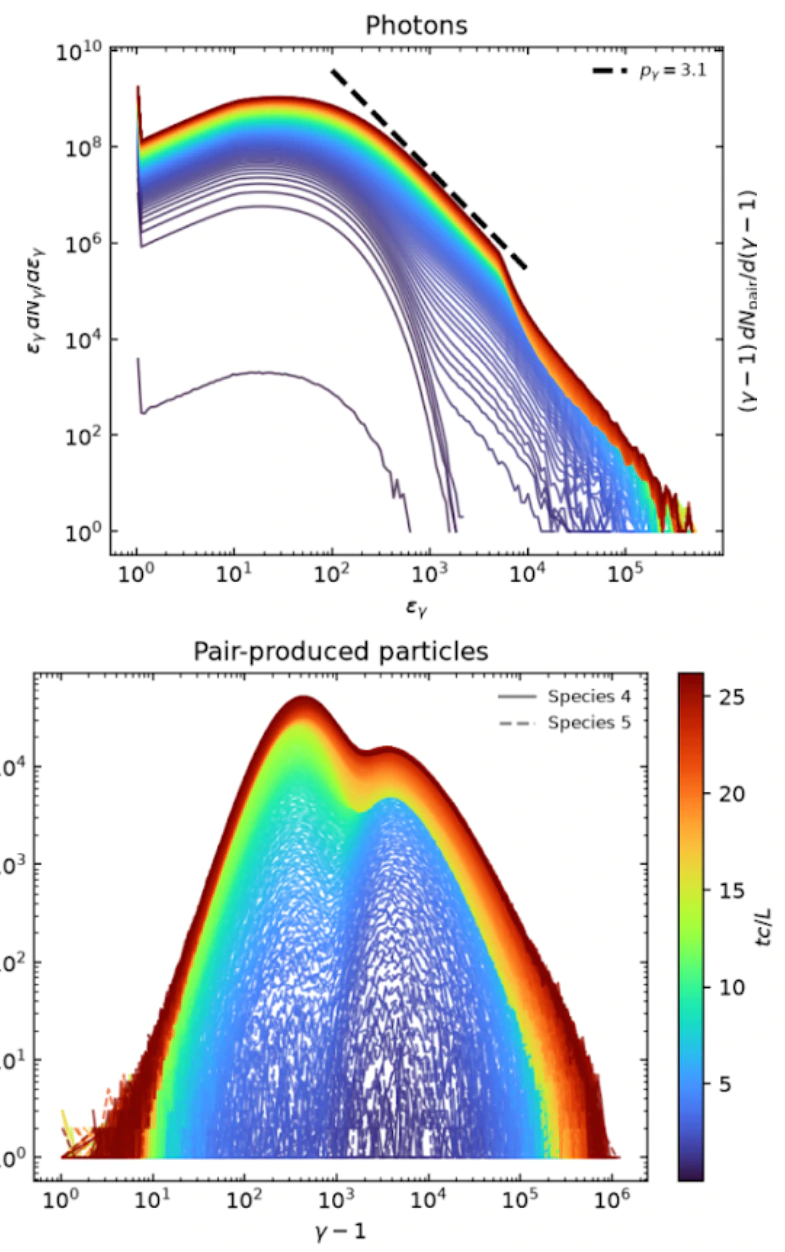
Near black holes, neutron stars, and other extreme environments, radiation is not merely a passive byproduct of plasma activity. Particles exchange energy with intense photon fields, high-energy photons create electron–positron pairs, and pairs can annihilate back into radiation. How turbulence energizes a plasma when these radiative and quantum-electrodynamic processes operate together remains an open problem, because the feedback can change the plasma composition, the energy available to each particle, and the spectrum of escaping radiation. This project studies that coupled system using self-consistent kinetic simulations that include inverse-Compton scattering, Klein–Nishina effects, pair production, and annihilation. By sustaining turbulent driving together with consistent particle and photon sources and sinks, we investigate how the plasma reaches a statistical steady state in which radiation, pair loading, and particle energization regulate one another, and how this balance shapes high-energy emission from astrophysical sources.
In collaboration with Dr. Alexander Chernoglazov at IAS/Princeton.
Can relativistic turbulence supply its own electron–positron pairs?
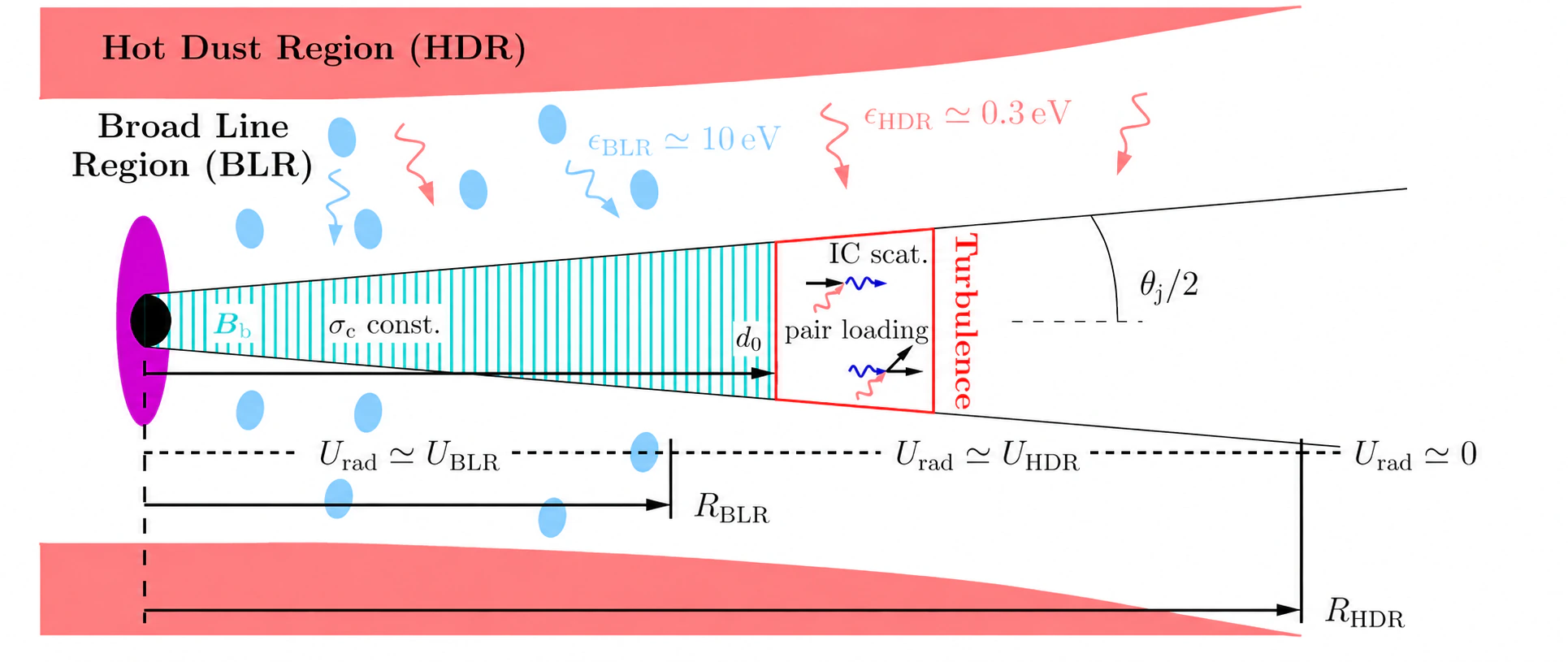
Blazars are among the brightest gamma-ray sources in the universe, powered by relativistic plasma jets launched from supermassive black holes, yet two basic questions remain connected and unresolved: how these jets accelerate particles to extreme energies, and what particles the jets are made of. We investigate whether radiative turbulence can link the two. Turbulence initially accelerates electrons and positrons faster than radiation can cool them, producing energetic gamma rays; when those gamma rays encounter softer radiation surrounding the jet, they can be absorbed and converted into new electron–positron pairs, loading the jet with additional plasma. Using theory, particle-in-cell simulations, and Fokker–Planck modeling, we show that this pair loading creates a self-regulating cycle: the growing pair population lowers the energy available per particle, slows further acceleration, and eventually brings acceleration into balance with radiative cooling, shutting off additional pair creation. Applied to flat-spectrum radio-quasar jets, this mechanism can produce substantial in situ pair loading and provides a direct connection between turbulent particle acceleration, gamma-ray emission, and the composition of relativistic jets.
Related publications
The Astrophysical Journal, 987(2), 159 (2025).
Led by collaborator, Dr. Lizhong Zhang at IAS/U Columbia
How do radiation and plasma dynamics interact in general-relativistic systems?
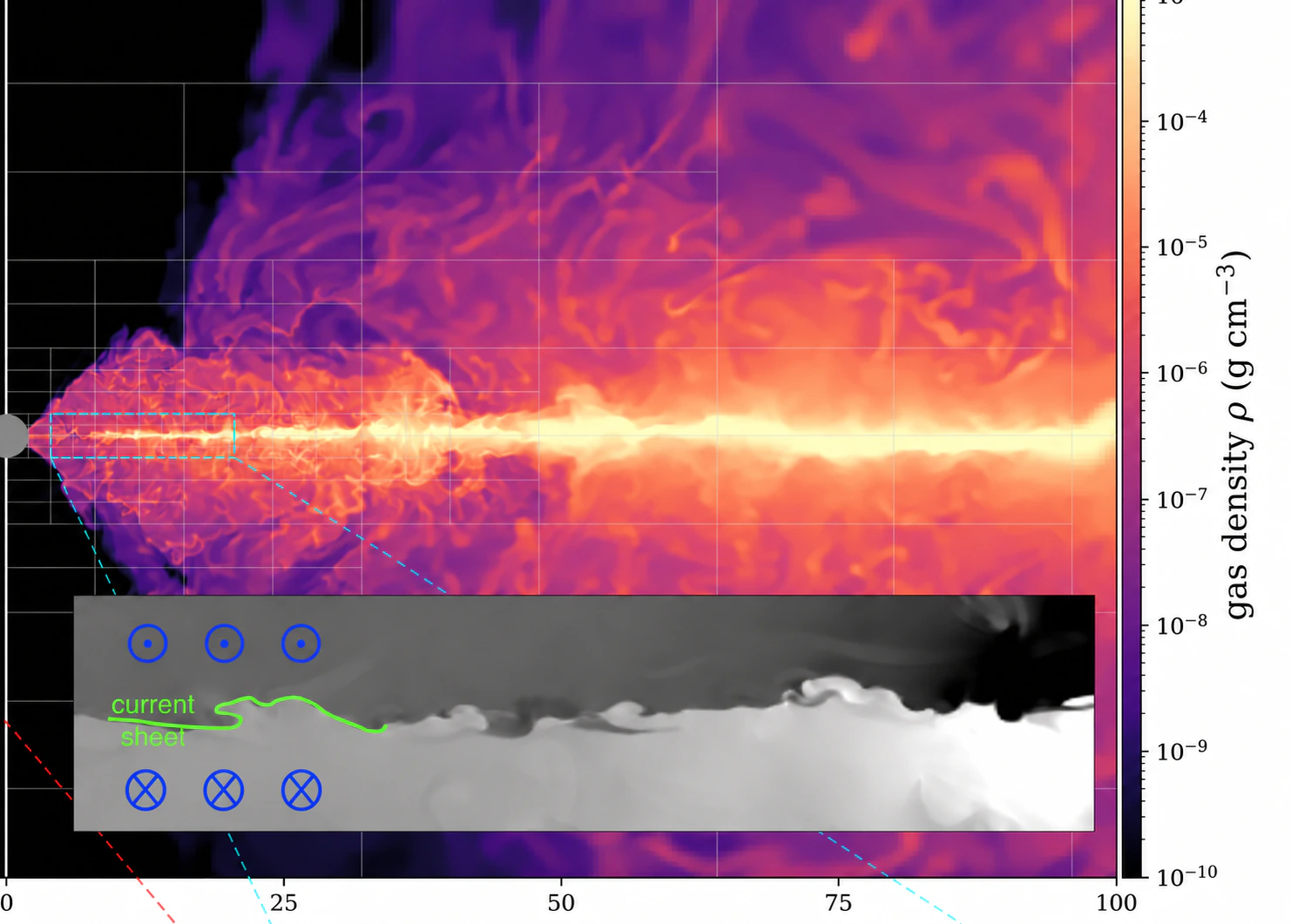
Accretion onto black holes powers some of the brightest objects in the Universe, from X-ray binaries to quasars. Yet we still do not fully understand how an accretion disk transports angular momentum, releases gravitational energy, and converts that energy into radiation. The standard thin-disk picture treats transport and heating as local processes, but its predicted instability in radiation-dominated disks motivates a more complete model combining strong gravity, radiation, and large-scale magnetic fields.
Using high-resolution radiation-GRMHD simulations, we find that efficient cooling can concentrate most of the gas into a razor-thin global current sheet at the disk midplane. Reconnection in this layer dissipates energy and produces radiation, while much of the inward mass transport occurs through magnetized envelopes above and below it, driven by large-scale magnetic torques. This layered structure offers a new picture of the organization, stability, and emission of luminous accretion disks.
Related manuscript in progress
In preparation